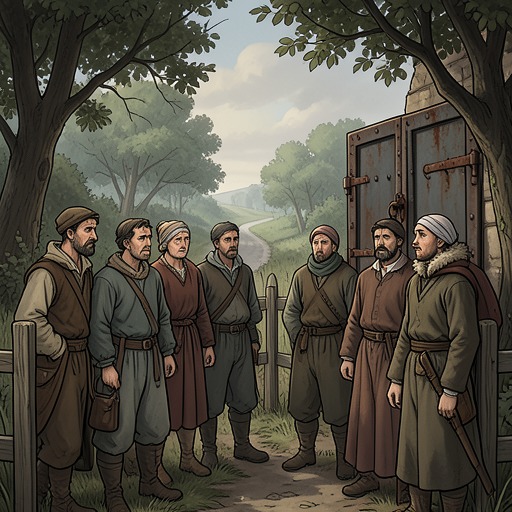
The Lipce villagers’ confrontation with the German settlers over Podlesie
The PeasantsThe Lipce villagers’ confrontation with the German settlers over Podlesie turns a dispute about land into a test of whether Lipce can act collectively without renewing the ruinous conflict that came before. The villagers try persuasion first, but their appeal meets a firm refusal. As Rocho leads them away, the confrontation remains unresolved: solidarity has brought them to the settlers’ door, yet anger threatens to turn a petition into open violence.
Background and Mobilization
The confrontation takes shape in the days between Corpus Christi and Sunday, when Mateusz, Grzela, and other young men abandon their work and go from cottage to cottage urging the villagers to drive the German settlers of Podlesie away. The canvass is not an immediate success. Jankiel, the innkeeper, offers drink and credit to help persuade the more reluctant, while older villagers hesitate and the women oppose any attack. They remember the recent forest conflict and fear that Lipce has barely finished serving time for it before being drawn into another disaster.
Grzela adjusts his approach rather than simply repeating his demand. He persists through closed doors, speaks with people in their gardens and fields, and explains the advantages of the land by drawing the Podlesie plots on the ground. The details matter: he turns a general appeal into a claim villagers can picture in terms of specific fields and possible benefit. When his efforts alone fail to bring the community together, he and the other organizers ask Rocho for help behind Boryna’s barn. Though he recognizes their method as questionable, he agrees that there is no time for another approach and offers to assist.
Rocho then seeks the Parish Priest of Lipce, who at first reacts angrily and refuses to listen. The two eventually sit together on a field boundary and confer at length. The priest subsequently visits the farmsteads, speaking especially with the women, and quietly urges them to act while there is still time, promising to approach the squire himself. His intervention changes the balance: the women no longer object, and farmers who had been arguing begin to regard the plan differently because the priest supports it. By early Sunday, the villagers have agreed to go after Vespers, with Rocho at their head because he can speak to the Germans in their own language.
The Delegation Sets Out
On the appointed evening, Rocho comes out among the people, crosses himself, and calls them to set off in God’s name. The peasants march down the road, with women and children following. The approach is deliberate and tense. As the villagers draw near, their steps grow slower and heavier; they grip their staffs, suppress their panting, and face the settlers with fixed, defiant expressions. Rocho opens the exchange in German with a greeting, while the villagers gather behind him shoulder to shoulder.
The encounter initially takes the form of a petition, not an attack. Rocho speaks for the whole village and asks the German settlers not to buy Podlesie. The villagers affirm his appeal, striking their staffs, while the settlers stand stunned. Rocho repeats the request in German so that there can be no doubt about what the delegation has come to ask. This effort to speak across the language divide gives the gathering a brief possibility of negotiation, even as the tightly formed groups and the villagers’ weapons make the danger plain.
Refusal and Escalation
The settlers reject the request. They insist that they have bought Podlesie, that it belongs to them, and that it will remain theirs; anyone who dislikes the purchase, they say, should keep away. Grzela answers that the villagers want the settlers to keep their hands off the land. The exchange exposes the conflict beneath the villagers’ demand: the settlers assert ownership through purchase, while the villagers treat the change of ownership as a threat to their community and its claims to the place.
Mateusz breaks the fragile restraint of Rocho’s diplomatic appeal with an insult. The German settlers erupt, shouting and crowding together; some raise their fists toward the villagers. The peasants hold their ground like a wall, though their hands shake and their teeth are clenched. The danger is no longer merely implied. The women watch anxiously from the windows, children hide inside, and large dogs growl by the houses as the two groups face each other in silence before the argument resumes.
As the crowd presses closer, Mateusz steps in front of the Germans and accuses them of answering a peaceful, good-faith approach with threats and mockery. He declares that, if they reject peace, the villagers will resist their settlement. His warning invokes the villagers’ lack of courts, officials, and money compared with the settlers’ advantages, but turns that imbalance into a promise of resistance by day and by night. The villagers answer together with a cry for war and an appeal to God. The dispute has shifted from a request to refrain from buying the land to a threat of sustained hostility.
Retreat and Significance
The Germans reach for long poles, and some fetch rifles or stones. The villagers’ threats and insults continue as the groups stand close, staffs striking and hands extended, but Rocho gathers his people and leads them back. The villagers retreat watchfully, turning their backs only with care and calling mockingly over their shoulders. Their withdrawal prevents the standoff from becoming a fight at that moment, but it does not resolve the ownership dispute or erase the threats made on either side.
The confrontation shows both the force and the limits of Lipce’s collective action. Grzela’s persistence, Rocho’s language skills, and the Parish Priest of Lipce’s influence help assemble a delegation from a village divided over the risks. Yet the attempt to ask rather than seize or attack the land lasts only briefly before Mateusz’s anger and the settlers’ refusal transform it into mutual intimidation. The villagers arrive as a community speaking through Rocho; they leave still together, but without an agreement. Podlesie remains the focus of a conflict whose stakes are made visible in the distance between a peaceful petition and the villagers’ vow of war.